
How the AIS Works
The AIS revolutionizes how companies operate by offering better customer services, more services, and more opportunities to sustain their business into the future.
Edison’s Advanced Infrastructure System (AIS)

Edison’s Advanced Infrastructure System (AIS) is a game changing technology empowering many large-scale opportunities. Simply put, the AIS costs what you’re already spending on technologies unable to meet real-world demands. The AIS pays for itself in many unique and powerful ways! No other product accomplishes this not even close.
What is the AIS and what does it Do?
The AIS (Advanced Infrastructure System) is an energy and communications management ecosystem replacing legacy metering products, circuit control, and telecom products at the consumer end of the electrical utility/telecom continuum. Where legacy smart meters stop before the circuit breaker panel, the AIS is breaker control, prioritized circuit level submetering, and an energy management system. The AIS allows consumers to prioritize circuits needed for survival (HVAC, Durable Medical Equipment, etc.) during load shedding events, while the utility and consumer control and collect actual energy usage data by circuit within a residence or business.
While software achieves a great many things, it is limited with existing physical infrastructure and in context, is reliant on the antiquated and limited functionality of legacy smart meters. Our AIS corrects and resolves these limitations, provides near real-time data, and makes for a more reliable and safer grid.
In addition, because of the communication functionality, the AIS more efficiently resolves broadband demand in areas where delivering broadband is costly or does not allow for an easy laying of cable or fiber reducing churn.
The weakest link is the legacy smart meter. These products do collect data which is then interpolated through algorithms before the data is usable, and that requires time and some guesswork. Our AIS continually collects data by circuit and in addition, the AIS allows consumers and utilities to control appliances, for example, such as HVAC system to run more efficiently and for shorter durations.
The AIS uses an industry standard enclosure in a new home and replaces the internals of the existing panel in an existing home. The panel is composed of Smart/Digital Circuit Breakers for all used circuits, the AIS controller (an edge computer) to talk to the breakers, and an optional smart/digital main breaker.
The AIS User Interface is separate from the panel, to allow two-way communication between the consumer and the AIS, the utility, the telecom, and others. The interface displays information, notifications, charts, and other information for the consumer. The User Interface is also hosted on smartphones, PC’s, and digital speakers/assistants.
Edison partners provide external communications to/from the cloud and the AIS and other entities like the utility and/or the telecom and/or the government. An Edison partner, such as AWS, provides the cloud servers if a customer chooses to have Edison manage the cloud. This partner also provides the software interface to the cloud or to the customers cloud as primarily APIs to get information to/from the server for use in data analysis.
Competitive Comparison

The AIS System
System
The AIS System is composed of several subsystems. They are:
- AIS Main Panel
- AIS Controller
- AIS Next Gen Smart Breaker
- User Interface
- AIS Options
- DER, EV, VPP, and Apps
- Communications
- Server and API Software
AIS Main Panel
The AIS Main Panel integrates electric metering, measurement, control, diagnostics, and broadband into one Panel. The AIS Main Panel includes:
- The AIS Controller
- The AIS Next Gen Smart Breaker in every used slot
- The AIS Next Gen Smart Main Breaker (as/if required)
- Easy installation and setup in new or retrofit applications
- New AIS panel for new builds
- New AIS Panel internals for existing homes
- Consumers are able to install options, add apps, and replace breakers and modules as/if needed

- Security features to prevent tampering and theft
- Easy-wire application to main panel grid structure, not wired to breaker
- Multiple options for panel sizes and target environments
- Significantly lower cost than anything comparable on the market
- Customer branding available
- Reliable and easy to use
- Diagnostics of data from breakers
- Upgradeable to latest security protocols
- Enables utilities to manage power across the grid at a finer granular level
- Circuit level prioritized load shedding limits power disruption impact to customers
- Limits power loss to life sustaining devices during load shedding
The AIS Controller
- Edge processor for breakers
- Configures breakers per slot
- Maintains data via cloud for breakers and controller
- Processes diagnostics data from breakers
- Interfaces breakers and functions to the User Interface
- Multiple controllers centralized through single supervisor

- High Speed communication
- Black start options
Next Generation Smart Breaker
- All digital/electronic
- Current State-of-the-art safety features
- Breakers talk to controller via panel wiring, no IP Address needed
- Programmable options: Voltage, Current, tolerances, delays, etc.
- GFCI/AFCI/CAFCI built into breaker

- Smart Home via home wiring (as applicable), no IP Address needed
- Soft shutdown and startup, by slot or level
- Diagnostic Data per circuit, controller, user interface
- Additional sensors for temperature and vibration
- executes Black start options
- UL, ANSI, CSA, EMC, FCC, IEC, NEMA, RoHS (Hazardous Material) certifications and more as/if required per module
- Soft shutdown & startup by slot and/or level
- Granular diagnostic data including temperature and vibration
AIS User Interface
- The User Interface provides a 2-way communication between:
- The UI keeps the consThe AIS User interface (UI) is a 2-way communication interface between the consumer and the energy/communications supplier and/or carrier
- The User Interface provides a 2-way communication between the consumer
- The UI keeps the consumer updated on energy and comms usage as applicable
- Report power usage (submetering) at circuit level
- Shows usage at the device level with smart home option
- Allows the consumer to check usage by device, circuit, room, and other groupings
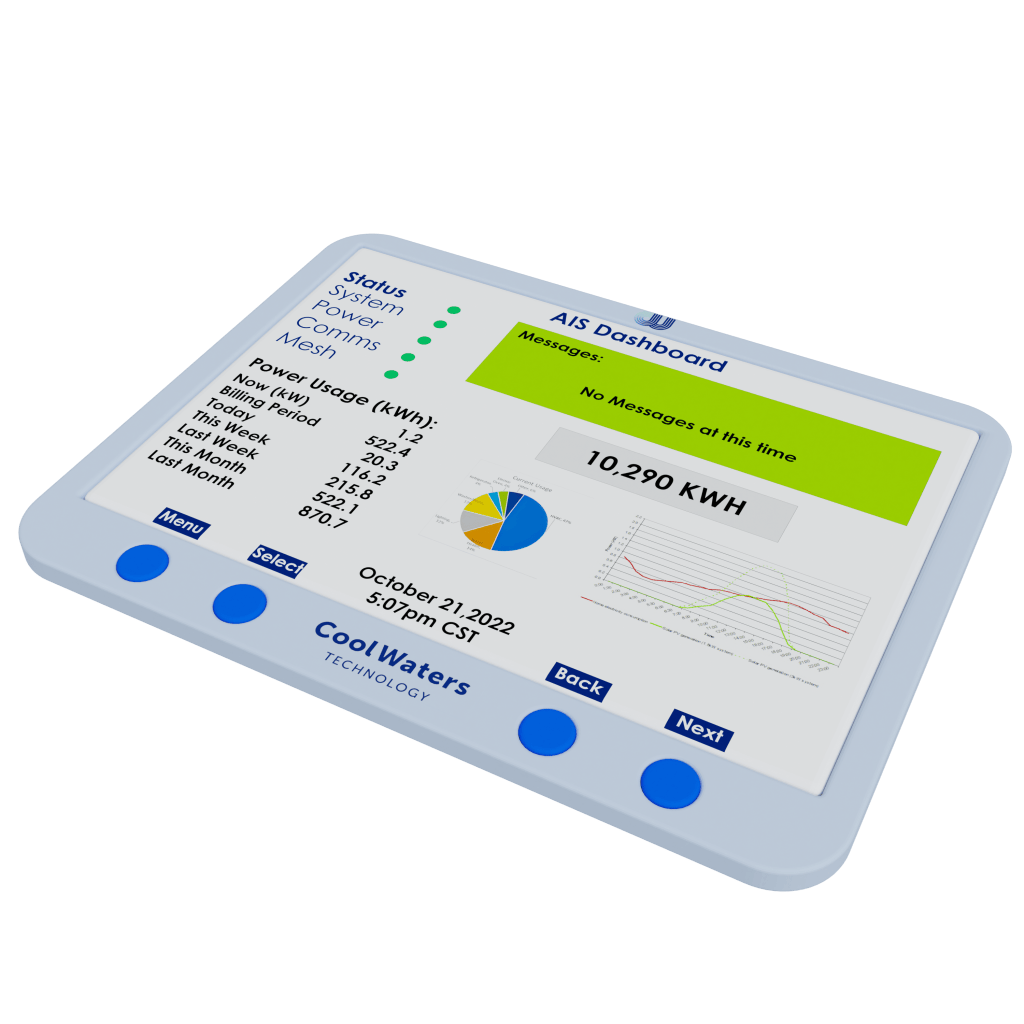
- Allows consumers to monitor their utility, telecom, DER, and VPP bills down to the penny
- Allows consumers to pay their energy and communication bills using a variety of payment structures, including debit/credit card, PayPal, other services even cryptocurrency
- The consumer uses the AIS User Interface to access vital information, such as local and national alerts or messages.
- The AIS shows emergency service capability, and allows search programs, banking services, commercial and government-based security services
AIS Options
The AIS offers various options at the panel level. The main options are:
- Distributed Energy Sources (DER)
- Interfaces with alternate energy sources including solar, wind, batteries, electric vehicles, microgrids, and more
- Interfaces to alternate energy controllers
- Reports status, data, and quality from the energy source
- Automatic switchover during power level emergency
- Reports on energy put back on the grid
- Does not allow energy source on the grid if quality does not meet requirements

- Electric Vehicle (EV) option
- Interfaces to Electric Vehicle controller
- The EV option provides automation at the AIS level
- The option works with other EV options per criteria like transformer, group, tag, substation, etc.
- Works with the VPP option to put EV power bag on grid
- Meters power into the EV and out of the EV to the grid with VPP option
- Virtual Power Plant (VPP) option
- Automates returning power to the grid when required in a energy emergency
- Works with alternate energy sources including Solar, Battery, EV, generators, and others
- Measures power and quality going back to the grid separately from the power going into the power source
Communications
- Multiple communication protocols (e.g. 4G/5G/6G/xG, Wi-Fi 6/7/x, Fiber, etc.)
- Future proof to handle future protocols
- External and Internal independent protocols
- High speed mesh network, local and long range
